Key Takeaways
- Prequalification is a quick estimate based on self-reported information. Preapproval is a verified commitment backed by documentation and a hard credit pull and produces a letter sellers actually trust.
- In competitive markets, sellers typically require preapproval. A prequalification letter alone often gets your offer passed over, especially as the share of first-time buyers hit a record-low 21% in 2025.
- Preapproval doesn't guarantee final loan approval. Mortgage application rejection reached 20.7% in 2024, a decade-plus high. What you do between preapproval and closing matters.
- Preapproval letters expire in 60–90 days (sometimes 30). Time yours carefully and don't apply six months before you're ready to make offers.
- Lenders don't always use these terms consistently. Per the CFPB, "prequalification" and "preapproval" mean different things at different institutions. Always ask exactly what their process verifies.
- Your credit score, debt-to-income ratio (DTI), savings, and income stability are the four variables that determine your outcome. Tracking them before you apply makes the lender meeting predictable, not nerve-wracking.
The median age for first time homebuyers in the United States hit age 40. The share of first-time homebuyers also fell to a record-low 21% in 2025, as well. As mortgage rejections and competition for houses climb to fresh highs, the difference between a prequalification letter and a preapproval letter can be the difference between an accepted offer and a polite rejection.
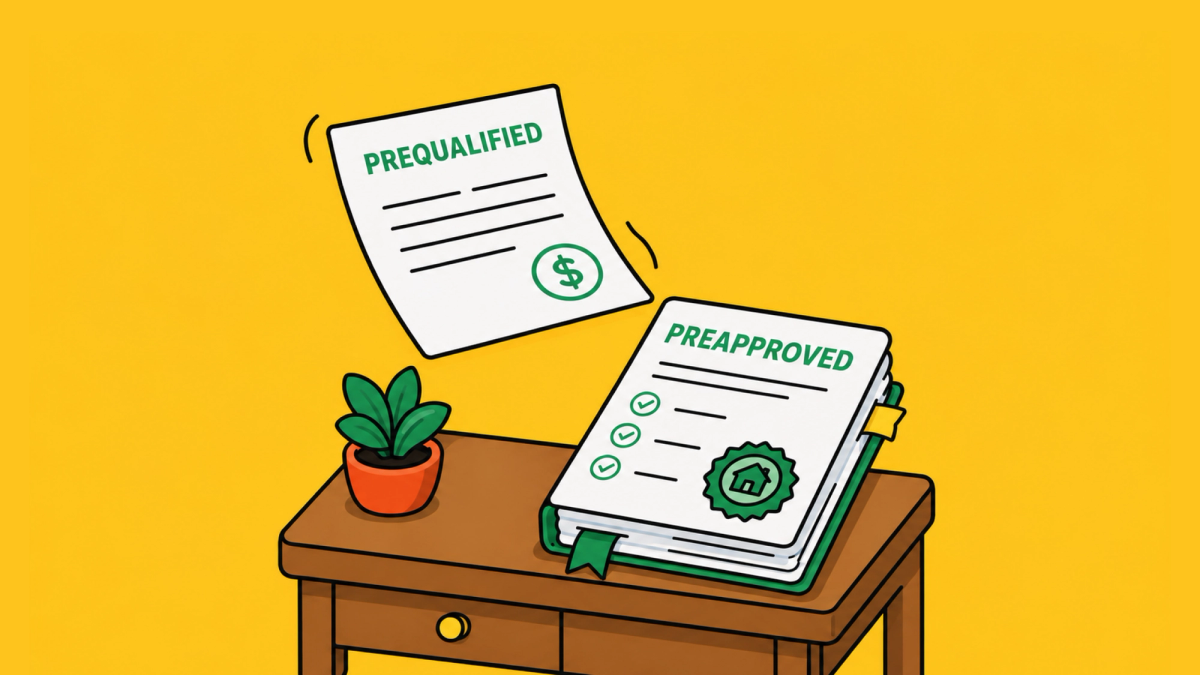
Prequalification estimates what you might qualify for. Preapproval verifies what you actually qualify for. We’re going to cover exactly when to use each, what they cost in terms of time and credit, and how to make sure your preapproval doesn’t turn into a denial at closing.
Quick Definitions
Prequalification is an initial estimate of your borrowing power based on self-reported financial information. This includes income, assets, debts, and typically a soft credit pull. It takes just minutes and doesn’t cost anything. However, it is unverified.
Preapproval is a formal evaluation in which a lender reviews your actual financial documents, runs a hard credit inquiry, and issues a conditional commitment letter with a specific loan amount. It carries weight with sellers when purchasing a home.
The core difference is that prequalification tells you roughly what ballpark you’re in. Preapproval tells you, and the seller, what you can actually do.
Side-by-Side Comparison: Prequalification vs. Preapproval
Prequalification | Preapproval | |
Time required | Minutes to hours | 1-10 business days |
Credit pull type | Typically soft (no credit score impact) | Hard inquiry (a minor and temporary impact to credit score) |
Documents needed | Self-reported income, assets, debt | Paystubs, tax returns, W-2s, bank statements, ID |
Output produced | Informal estimate letter | Conditional commitment letter with loan amount |
Validity period | Varies but often informal | 30-90 days (60 on average) |
Seller perception | Shows interest but not necessarily readiness | Strong, it shows your verified buying power |
Cost | Usually free | Usually free, but some lenders have an application fee |
Best for | Early research and budget setting | Active house hunting, making offers |
What is Mortgage Prequalification?
Prequalification is generally the first step buyers take when they’re starting to think seriously about buying a home. You tell a lender, or even complete an online form, your approximate income, monthly debts, and assets. The lender gives you a rough estimate of what you might be able to borrow.
The process typically looks like this:
- Submit basic financial information. Again this is self-reported and usually no documentation is required.
- The lender runs a soft credit pull, or no credit check at all.
- You receive an informal estimate of your borrowing range.
Because prequalification relies on information you provide rather than documents a lender verifies, it is fast and painless. However, the number it produces is only as accurate as the inputs. If your self-reported income or debts are inaccurate, then that will affect your estimate.
When prequalification makes sense: If you’re around six months away from actively shopping for a home, then it’s a good time to see what your budget should be. Figuring out your budget before speaking with a real estate agent is best. You’ll also want to compare loan types and lenders before committing to a preapproval process and hard credit pull.
What is Mortgage Preapproval?
Preapproval is a materially different process. A lender reviews your actual financial documents, evaluates your full credit profile, and issues a conditional commitment letter. This commitment letter means the lender is prepared to lend you a specific amount, subject to certain conditions such as a property appraisal.
The process typically involves:
- Submitting a full mortgage application.
- Providing documentation (see the below checklist)
- The lender runs a hard credit inquiry
- Underwriting reviews your income, employment, assets, and debt
- You receive a preapproval letter specifying the loan amount, rate type, loan term and type, estimated loan-to-value (LTV), and an expiration date.
Document checklist for preapproval:
- Two most recent pay stubs
- Two years of federal tax returns or W-2s/1099s
- Two most recent bank statements (all accounts)
- Government issued ID and Social Security number
- Documentation of your down payment source (if it’s a gift, a gift letter is required)
- For self-employed borrowers: 1099s and a current profit and loss statement
On the hard credit inquiry: a single hard pull typically drops your credit score by just a few points temporarily. THere is an important nuance however: FICO gives you a rate-shopping window. Multiple mortgage-related hard inquiries within 14-45 days typically counts as a single inquiry. So comparing offers from multiple lenders within that short window doesn’t compound the impact.
What’s actually in a preapproval letter: the maximum loan amount, loan type (conventional, FHA, VA, etc.) estimated interest rate type (fixed or adjustable), approximate LTV, and an expiration date.
Why Sellers Care: The Real Market Picture
According to the National Association of Realtors’ 2025 Profile of Home Buyers and Sellers, 88% of buyers worked with a real estate agent, and, as previously mentioned, first-time buyer share dropped to a record-low 21%. This context matters because it shapes what sellers see. Most offers they receive come from experienced buyers, who often have larger down payments, longer credit histories, and stronger financial profiles.
In that environment, a prequalification letter signals that you are interested. A preapproval letter signals that a lender has already done the leg work to verify you can close successfully. Sellers, and their agents, know the difference.
In competitive markets, preapproval often isn’t optional. It’s the price of entry for having your offer taken seriously. A lower offer with verified preapproval can outpace a higher offer with only a prequalification letter attached, because the seller’s primary concern is certainty they’ll be able to close the deal.
Prequalification is still acceptable in non-competitive situations including “For Sale By Owner” (FSBO) transactions, buyers’ markets, or family-to-family sales where the seller isn’t going to field multiple offers.
Does It Hurt Your Credit Score?
Step | Credit Pull Type | Score Impact | When It Happens |
Prequalification | Soft pull (or none) | None | At inquiry |
Preapproval | Hard inquiry | Typically a few points, temporarily | At application |
Rate shopping (multiple lenders) | Multiple hard pulls | Counts as one if within 14-45 days | During rate shopping window |
The short story is that prequalification won’t affect your credit score. Preapproval will produce a small, temporary dip. If you’re planning to apply for preapproval soon, avoid other hard inquiries (credit cards, auto loans) in the weeks before. If you’re shopping multiple lenders, which you should, do it within the FICO rate-shopping window so the inquiries consolidate.
How Long Does a Preapproval Last?
Most preapproval letters are valid from 60-90 days. Some lenders issue 30-day letters. Once your letter expires, you’ll need to go through the process again, with updated documents, a new hard credit inquiry, and a new letter.
The practical implication: don’t get preapproved six months before you’re ready to make an offer on a house. Get preapproved as you’re actively house hunting, and within roughly 90 days of when you’d expect to go under contract. If your search runs long and your letter expires, reach back out to your lender to renew.
Can You Be Denied After Preapproval?
Yes, you can be denied after preapproval, and it does happen every so often. The Federal Reserve’s 2024 Survey of Consumer Expectations found that mortgage application rejections hit 20.7%, the highest rate in more than a decade. Preapproval is a conditional commitment and not a guarantee.
Research from the Federal Reserve’s HMDA data analysis shows that denial rates jump 15-17% when you hit the 50% debt-to-income (DTI) threshold. So if your DTI ratio is near that line, any financial change between the preapproval and closing can shift your outcome.
The most common reasons for denial after preapproval (per HMDA data):
- DTI is too high, often because of new debt taken on after preapproval.
- Credit history issues are discovered during underwriting.
- Insufficient cash for down payment or closing costs.
- Employment history changes (job switch, gap, or self-employment)
- Appraisal issues (if the property doesn’t support the loan amount)
- Unverifiable or inconsistent information in the application.
- Incomplete application.
- Mortgage insurance denial.
What not to do between preapproval and closing:
- Don’t open new credit accounts (credit cards, auto loans, or anything).
- Don’t change jobs or shift to self-employment.
- Don’t make large, unexplained purchases.
- Don’t move significant cash between accounts without a clear paper trail.
- Don’t co-sign on anyone else’s loans.
Your financial profile at closing needs to match, or improve upon, your financial profile at preapproval. Treat the period in between like a financial freeze.
Which One Do You Need Right Now?
It depends on three things: your timeline, your market, and your financial readiness.
Timeline
- Less than 90 days out from making offers, get preapproved now.
- 3-6 months out, prequalify to set a realistic budget; preapprove when you’re closer.
- More than 6 months out, focus on improving your credit, reducing DTI, and building your down payment before starting either process.
Market
- In a competitive seller’s market a preapproval is mandatory. Prequalification won’t get your offer taken seriously.
- In a buyer’s market or FSBO transaction, a prequalification is often sufficient to start.
Credit and DTI readiness
- If your credit score could meaningfully improve in the next 3 months either through paying down balances, disputing errors, or letting inquiries age off, then prequalify now and preapprove later when your score peaks.
- If your profile is already strong, preapprove now and time your home search accordingly.
For Couples and Joint Applicants
When you apply together, lenders use the lower of the two credit scores to qualify the loan, not the average of the two. They also combine both borrowers’ income and debts to calculate a single DTI ratio. This means both partners’ financial pictures matter, and a weak spot in one affects both.
If one partner has meaningfully lower credit than the other, it’s worth weighing whether to apply jointly or have the stronger credit borrower apply solo (which would also exclude the other partner’s income from the calculation). There’s no universal right answer, as it depends on your specific numbers.
The key is that both of you can see the same full picture before you walk into a lender meeting. That shared visibility, across your credit, debt, income, and savings, is exactly what Monarch’s couples view is built for.
How Monarch Helps You Get Mortgage-Ready
If prequalification and preapproval are snapshots of your finances, Monarch is the full movie. The four variables that drive your mortgage outcome are your credit score, your debt-to-income ratio, your savings, and your employment stability. Monarch tracks all four in one place, so you can see exactly where you stand months before you apply. This way you can show up to your lender meeting with the numbers already lined up.
The net worth and accounts dashboard within Monarch aggregates every account, including all of your assets and liabilities. You will have the same complete picture your lender will scrutinize. No last minute scrambling to track down statements or forgotten balances.
The debt dashboard surfaces your total monthly debt obligations, sorted by balance or interest rate. Your DTI is simply your total monthly debt payments divided by your gross monthly income, Monarch will make finding these numbers simple so you can track it continuously and easily.
Credit score tracking lets you monitor your score trend in the months before applying, so you can time your preapproval hard pull when your score is at its highest rather than mid-dip from a recent inquiry or balance spike.
Lastly, there’s goals. Whether you’re paying down debt or saving a down payment, Monarch lets you model your readiness timeline. If you’re targeting a 20% down payment to avoid PMI, working to knock your DTI below the 43% qualified-mortgage threshold, or building your emergency fund alongside your down payment, Monarch can show you when you’ll get there given your current trajectory.
Know Your Numbers Before Your Lender Does
Prequalification is an estimate. Preapproval is verified commitment. In a market where first-time home buyer share is at a 40-year low, and rejection rates are at a decade high, showing up with an unverified offer is showing up with a weak offer.
The buyers who win in this market know their numbers before they walk into a lender’s office. They know their credit score, their DTI ratio, and their down payment timeline. Start tracking these numbers now, before you really need them, so when the right house appears, you’re ready to make a move.
FAQs
Is preapproval better than prequalification?
For making offers in competitive markets, yes, definitely. Preapproval carries real weight because it’s backed by verified documents and a conditional lender commitment. For early-stage research, prequalification is often the right first step. They serve different purposes at different points in the process.
Can I get preapproved without a real estate agent?
Yes. Lenders and real estate agents are entirely separate. You can get preapproved before you’ve spoken to an agent, which can actually help you have more productive early conversations about budget and target neighborhoods.
Does prequalification mean I’ll get the loan?
No, and neither does preapproval. Both are conditional, and final loan approval happens at closing, after underwriting reviews the specific property and confirms nothing material has changed in your financial profile.
How much does preapproval cost?
Usually nothing. Most lenders don’t charge for preapproval. Some charge an application or credit check fee, typically ranging from $25 to $100. Ask about fees upfront.
Can I switch lenders after preapproval?
Yes, preapproval doesn’t lock you into a lender. You can get preapproved by multiple lenders, compare terms, and choose the best offer. Just do your rate shopping within the FICO mortgage window (14-45 days) to minimize the credit-score impact.
What credit score do I need?
Conventional loans typically require a minimum of 620. FHA loans can go as low as 580 (with a 3.5% down payment) or 500 (with 10% down). VA and USDA loans don’t set official minimums, but most lenders have overlays around 620-640. Higher is always better as it affects your rate, not just your approval.