
The financial aid refund hits your account in August, and for a few days you feel rich. Then real life happens: a textbook here, a grocery run there, a dinner out with new friends. By midterms the balance is thinner than you expected, and you are not sure where it went.
That gap between "I have money" and "can I afford this?" is what a college student budget closes. This guide turns your lump-sum refund into a real monthly number. You will sort fixed costs from flexible ones and set limits you can live with.
By the end, you will know what you can spend this week without the mid-semester panic.
Key Takeaways
- Turn each semester aid refund into a monthly number so it lasts the whole term, not just the first weeks.
- Cover fixed costs first, then set limits on flexible spending like food and going out.
- Pick one budgeting method that fits your income; irregular money works best with a one-number budget.
- Automate savings and autopay so sticking to your budget takes willpower out of the equation.
- Start an emergency fund of $1,000 or one month of net income, whichever is higher.
What is a College Student Budget
A college student budget matches your income against your fixed and variable expenses for a set period. Your income might include financial aid refunds, a job, scholarships, and family help.
Because aid often arrives as a lump sum each term, the smart move is to divide it into a monthly number. Cover your fixed costs first, then set limits for everything else. That one shift, from a windfall mindset to a monthly number, keeps the money from disappearing by midterms.
Here is the part most guides skip: a student budget works best as a semester budget divided into months, not a flat monthly plan. Your paycheck-style income is rare.
Most of your money shows up as a credit balance refund. Federal Student Aid describes it as money left over "after your financial aid is applied toward tuition and fees." Map the whole term, then spread it out.
Budgeting also covers far more than tuition. Your school lists a cost of attendance (COA), its official estimate of total yearly costs, covering housing, food, transportation, and books. But the sticker price is not what most people pay.
Your net price is what you actually owe after grants and scholarships, and it can be far lower. For 2025–26, College Board reports tuition and fees from $4,150 in-district at a public two-year college to $45,000 at a private nonprofit four-year school. Once you add living costs, College Board's low- and moderate-cost student budgets range roughly $26,150 to $39,030 for the 2026–27 year.
Your budget is the tool that keeps all of that in view.
Why Budgeting in College Matters
Money stress is not a side issue in college. It changes whether you stay.
In a national Ellucian survey, 59% of college students considered dropping out due to financial stress. Nearly 80% said it took a toll on their mental health.
College budgeting does not fix your income. But it gives you something more useful right now: a clear picture of what you have and where it goes.
That clarity turns "I have no idea if I can afford this" into "here is what I can spend this week." You do not need more willpower. You need better information.
How to Build a College Budget in Five Steps
Building a budget is not complicated. These five short steps show you how to make a budget and stick to it. You can build a college student budget in an afternoon.
List All Your Income Sources
Start by making a list of every source of money that reaches you, not what you wish you earned. Some sources are steady, and some arrive in one lump:
- A job or Federal Work-Study: a steady paycheck. Federal Work-Study helps students with financial need "earn money to help pay education expenses".
- Financial aid refunds: the leftover balance after aid covers tuition and fees. Schools usually pay it once a term, after you file the FAFSA.
- Scholarships and grants: money you do not repay. It often lands once a term, too.
- Family help: if it is steady, add it. Money saved in a 529 plan may cover tuition, freeing other money for living costs.
2. Turn Semester Lump Sums into a Monthly Number
Now take the lumpy sources from your list and turn them into a monthly figure. When a financial aid refund lands, do not treat it as spending money for October. Divide it by the number of months in the term.
A $3,000 refund across a five-month semester is $600 a month, not a $3,000 shopping spree. Do this for each lump sum and add it to your steady monthly income. Now you finally have a real monthly number to plan against.
3. List and Categorize Your Expenses
Split every expense into two buckets, and it helps to know the difference right away.
- Fixed expenses stay about the same and are hard to change fast: rent, phone bill, insurance, a prepaid meal plan.
- Variable expenses move with your choices: groceries, dining out, rideshares, going out with friends, clothes.
It also helps to sort those costs into needs vs. wants. Needs like rent, food, and transportation keep your life running. Wants like dining out and going out are the first place to trim when money is tight.
If you want a fuller list to work from, these budget categories cover almost everything a student spends on. Fixed costs anchor your budget. Variable costs are where you have the most control, so that is where limits do the most work.
4. Set Your Spending Limits
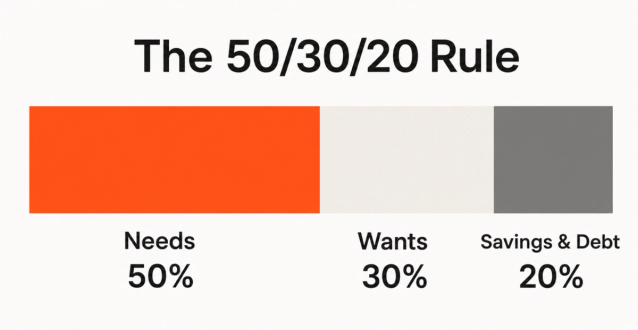
Now assign a limit to each category so your total spending stays under your income. A simple starting point is the 50/30/20 rule: about half to needs, a third to wants, the rest to savings and debt. Treat those percentages as a baseline, not a law, and adjust them to your real numbers.
5. Review it Every Week
A five-minute check every week beats one painful reckoning at the end of the month. Look at what you spent, notice where you drifted, and adjust the next week. This weekly habit is one of the surest ways to make a budget stick: you catch problems while they are still small.
Budgeting Methods that Work for Students
There is no single right method. The best one is the one you will actually keep using. Here are four that fit student life.
The 50/30/20 Rule
The 50/30/20 rule splits your after-tax income into needs, wants, and savings. Elizabeth Warren and Amelia Warren Tyagi popularized it in their 2005 book "All Your Worth". It predates every budgeting app.
The percentages are guidelines. If rent eats more than half your income, which is common near campus, shift the split and keep moving.

Zero-Based Budgeting
With zero-based budgeting, every dollar gets a job before the month starts, so income minus expenses equals zero. That does not mean you spend everything; savings is one of the jobs.
This method gives you the most control. It works well when your income is steady enough to plan down to the dollar.
Pay Yourself First
Flip the usual order: save before you spend, not after. Federal Student Aid recommends you "include 'Savings' as a fixed expense in your monthly budget. Pay yourself first every month!".
Set aside a small amount the moment money arrives, and whatever is left is genuinely free to spend.
The One-Number Budget
If your income is irregular, this one is for you. Cover your fixed costs, set aside savings, then collapse all flexible spending into a single weekly number.
You do not track twelve categories. You track one: "I have $80 this week for everything fun and flexible."
It is the easiest method when money arrives in lumps instead of steady paychecks. It is exactly how Monarch's flex budgeting works.
What a Real College Student Budget Looks Like
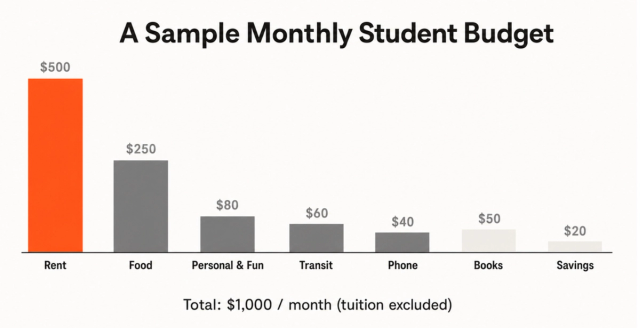
Most guides stop at categories and never show real dollars. Here is a sample monthly budget for a student living off campus, tuition excluded. Copy this table into a spreadsheet or Monarch and use it as your own college budget template.
One line may be new: the books-and-supplies sinking fund. A sinking fund means setting aside a little each month for an expense that is not monthly, like textbooks each term.
Category | Type | Monthly Amount |
Rent (shared apartment) | Fixed | $500 |
Food (groceries + some dining) | Variable | $250 |
Transportation (transit pass) | Fixed | $60 |
Phone | Fixed | $40 |
Books and supplies | Sinking Fund | $50 |
Personal and fun | Variable | $80 |
Savings (pay yourself first) | Fixed | $20 |
Total Spending | $1,000 |

Your numbers will differ, and that is the point of building your own. Two quick examples show the range.
A freshman living on campus with a paid meal plan might spend near $600 a month out of pocket. That is mostly variable costs like snacks, laundry, and going out.
A working senior with an apartment and a car might run closer to $855 a month, excluding tuition. Rent and transportation move into their column of responsibilities.
Here is how the four methods compare so you can pick fast.
Method | Best For | How It Works |
50/30/20 | Beginners who want a simple split | Needs 50%, wants 30%, savings and debt 20% |
Zero-based | Steady income, detail lovers | Every dollar gets a job; income minus expenses is zero |
Pay yourself first | Anyone who struggles to save | Save a set amount first, spend the rest |
One-number | Irregular or lump-sum income | One weekly figure for all flexible spending |
Monarch Pro Tip: When you connect your accounts in Monarch, your categorized transactions show your real totals. You get to build your college student budget from facts instead of estimates.
How to Budget Your Financial Aid Refund
When a refund lands, treat it as living-cost income for the whole term, not a bonus. Take a few steps before you commit the rest.
- Cover the essentials first: pay rent and buy books while the money is there. These costs hurt most if you fall behind.
- Set aside an emergency buffer: move a small slice into savings the day the refund arrives, so a surprise expense cannot derail you.
- Keep a little for you: set aside a small amount to enjoy before allocating the rest.
- Avoid lifestyle creep: a big balance feels like permission to upgrade everything. Spread it across the months instead, and your future self stays covered.
How to Cut Your Biggest Student Expenses
You do not have to cut your social life to cut costs. You just have to aim at the biggest, most flexible expenses first.
Textbooks
New textbooks are one of the easiest wins. Before you buy new, check whether you can rent, buy used, or get a digital edition.
Many campus libraries keep required texts on course reserve, so you can borrow them free. Compare a few options each term, because the savings add up fast.
Food and Dining Out
Food is where variable spending quietly balloons. The Bureau of Labor Statistics found in 2024, "food away from home" averaged $3,945 per household while food at home averaged $6,224.
You are one person, not a household, but the ratio holds. Cooking even a few more meals a week reclaims real money.
Use your meal plan fully if you have one. Treat dining out as a planned want, not a default.
Transportation
Skip the car costs you can avoid. A student transit pass usually beats gas, insurance, and a parking permit.
If you carpool or bike, even better. Before you buy a campus parking permit, ask whether you will use it enough to justify the price.
Subscriptions and Student Discounts
Audit your recurring charges once a term. Streaming services, apps, and old free trials that started charging are easy to forget.
Cancel what you do not use, and always ask for the student rate. Software, news, transit, and even some restaurants discount for a valid student ID.
Monarch Pro Tip: In Monarch you can see your recurring subscriptions in one list. Spot the $12 charge you forgot and cancel it in a minute.
Take Community College Credits
Knocking out general-education credits at a community college is one of the biggest levers you have. The National Center for Education Statistics reports average tuition and fees of $4,000 at public two-year colleges in 2022–23, versus $9,800 at public four-year schools. Take those credits, then transfer them back toward your four-year degree.
Become a Resident Assistant (RA)
Becoming a resident assistant (RA) often earns free or discounted housing, and sometimes a meal plan. That erases the single biggest line in most student budgets. Ask your housing office how to apply for next year.
Real Talk About Sticking to a Budget
"Budgeting feels pointless when I'm already broke." A budget matters most when money is tight. It cannot create cash, but it tells you what you can actually spend, so nothing catches you off guard.
"I don't want to give up my social life." Budgeting is not about cutting fun. It is about giving fun its own line, so you can say yes to plans without the guilt.
"I keep abandoning my budget by week two." Start smaller: track one number, expect to adjust, and give yourself room to tweak. A budget you adjust beats a perfect one you quit. And if you fall off, do not scrap it, just reset your budget and pick back up.
How to Actually Stick to Your Budget
Making a budget is the easy part. Sticking to it is the real challenge, and the students who succeed lean on systems, not willpower. A few proven budgeting habits make the difference.
Automate the Boring Parts
Set up autopay for at least the minimum on every account, so a late fee never sneaks up on you. Then automate your savings: Federal Student Aid advises you to treat savings as a fixed expense and "pay yourself first every month."
An automatic transfer the day money arrives removes the monthly decision. A decision you never have to make is one you can never skip.
Build a Small Emergency Fund
An emergency fund keeps one flat tire from becoming a credit card balance. Federal Student Aid notes "the ideal amount of an emergency fund typically covers three to six months of your expenses".
The right target is situational. Aim for roughly three, six, or nine to twelve months depending on your dependents, how stable your income is, and similar factors.
Begin with $1,000, or one month of net income if that is higher, and build from there. Any buffer beats none.
Monarch Pro Tip: Set your emergency fund as a Goal in Monarch. You can watch each transfer grow your balance and keep the habit going.
Budget With a Roommate or Partner
Shared costs go smoother with shared visibility. Treat your roommate or partner as your household, and give both of you a shared view of who paid for what. When you both see the same picture, money friction drops and the awkward "you owe me" conversations mostly disappear.
Agree on shared categories, split them clearly, and check in the way you check your own budget.
Building Credit Carefully as a Student
College is a smart time to start building credit, as long as you do it carefully. A student credit card used well builds a history that helps you rent an apartment and land better loan rates. Used carelessly, it becomes expensive debt fast.
Keep your credit utilization, the share of your limit you actually use, under 20%. Under 10% is even better. You will often see 30% quoted as a rule, but that is the industry ceiling, not the goal.
Set up autopay for at least the minimum on every account so you never miss a payment. Payment history matters most.
Check your credit regularly. Look at both your FICO and VantageScore at least quarterly, so you catch errors and track progress.
Order matters here. Open your student credit card first, then freeze your reports at all three bureaus. A freeze is free, does not affect your score, and blocks new accounts opened in your name.
When you apply for new credit later, temporarily thaw the freeze, then re-freeze once you are approved. Consider doing the same for family members.
What Monarch Shows: Monarch shows your VantageScore 3.0 via Equifax using a soft pull. This may differ from the FICO score a lender sees, since scoring models and bureaus vary.
How Monarch Can Help
You want two things from a budget: to see everything in one place, and to actually stick to the plan. Monarch takes the manual work off your plate so you can focus on the decisions.
- All your accounts in one view: connect your accounts to track every transaction automatically. You update your budget without manual entry.
- Flexible budgets: set limits that bend to lump-sum income and semester rhythms, so your plan fits how student money arrives.
- Automatic subscription detection: see recurring charges in one place so nothing slips through. Set an emergency fund as a Goal and watch it grow.
Monarch is subscription-only, with no ads and no data sales, so its incentives line up with yours instead of an advertiser's.
Ready to stop wondering where your money went? Monarch pulls your whole college budget into one view, so you always know what you can spend this week.
A good college student budget is simple, built on your real numbers, and easy to check often. Turn your semester income into one monthly figure, cover fixed costs first, and set limits for the rest.
Pick one method, automate a small savings transfer, and review it weekly. The habit you build now carries into every paycheck for the rest of your life.
FAQs
How much should a college student budget per month?
Excluding tuition, many students run between about $600 and $855 a month, depending on whether they live on or off campus. Build your own number from your real income and fixed costs.
How much should a college student spend on food per month?
Around $250 a month works for many students who mix groceries with some dining out. Cooking more meals and using a meal plan fully brings that number down.
What are the biggest expenses for college students?
After tuition, housing is usually the largest, followed by food and transportation. These are where smart choices, like a shared apartment or a transit pass, save the most.
How can college students save money?
Rent or buy used textbooks, use a transit pass, cook more meals, and ask for the student rate on subscriptions. Taking general-education credits at a community college can save the most.
Should a college student have a credit card?
A student credit card used carefully builds a credit history that helps you later. Keep your balance under 20% of the limit and set up autopay so you never miss a payment.