
Health Savings Accounts (HSAs) and healthcare flexible spending accounts (FSAs) can be a great way to save for healthcare costs in a tax-advantaged way, if you use them right. Nearly half (47%) of FSA holders forfeited unused funds in its most recent survey, losing an average of $436 each and $4.5 billion across the United States, according to the Employee Benefit Research Institute.
Knowing the difference between an HSA and FSA is crucial if you don’t want to lose your savings. While HSAs allow you to keep your funds forever, FSAs are a one-year bet you try to predict during the enrollment period. Whether you predict your expenses correctly, and how you can use each type of account to your advantage, will determine how far your savings can go.
Key takeaways
- HSAs let you keep your funds permanently; FSAs are use-it-or-lose-it. Because HSA funds roll over year to year, it’s a great way to save for the long-term. FSAs are riskier because you forfeit any unspent funds at the end of the plan year, or when you leave your employer.
- HSAs require a high-deductible health plan, FSAs require an employer plan. That means only HDHPs and certain Marketplace plans offer an HSA. FSAs, on the other hand, are available for any plan type if your employer offers them.
- 2027 HSA limits are $4,500 for self-only and $9,000 for households with $1,000 in catch-up contributions for those over 55. The 2026 health FSA limit is $3,400; the IRS is expected to announce the 2027 figure in October.
- You can’t contribute to both a general-use healthcare FSA and HSA at the same time. You can, however, contribute to an HSA if you have a limited-purpose FSA or dependent care FSA.
- How much you elect to contribute to an FSA is locked at enrollment, or during a qualifying life event. HSAs allow for changes at any point during the year.
- If your spouse is covered by an HSA, you can’t contribute to an FSA, and vice-versa. Coordinate with your partner on whether you want to keep coverage under your HSA, which has a household limit of $9,000 for 2027, or both have an FSA, which has a combined household limit of $6,800 for 2026 for two individual accounts.
What's the difference between an HSA and an FSA?
HSAs and FSAs are similar in several ways, but have a few key differences that set them apart. Here are the key differences in a nutshell.
HSA | FSA | |
What it is | Tax-advantaged long-term savings account used for qualified healthcare expenses | Tax-advantaged, employer-provided yearly savings account used for qualified healthcare expenses |
Eligibility requirements | Generally only available through HDHPs and eligible Marketplace plans | Only available through employer accounts |
2027 contribution limits | $4,500 self-only $9,000 family | $3,400 per employee* *Figure shown is the 2026 limit — the IRS has not yet announced the 2027 amount |
Who owns the account | You own the account | Your employer owns the account |
Rollover/forfeiture rules | All funds roll over from year to year | Unspent funds are forfeited at the end of year/grace period |
Portability | Portable between jobs, with rollover options for new accounts | Not portable between employers, though unspent funds are generally available until year end |
Mid-year changes | Elected contributions can be changed at any time, though mid-year job or insurance changes may impact contribution limits | Elections cannot be changed except during the enrollment period or a qualifying life event |
Investment/growth options | Funds can be invested or bear interest, depending on plan | None |
When funds become available | Once funds have been deposited in the account | Immediately after fund opens (January 1 onward or after first employment date) |
Catch up contributions | Additional $1,000 if over 55 | None |
Here are the different types of savings accounts in more detail.
What is an HSA?
A Health Savings Account (HSA) is a tax-advantaged savings account that comes with certain health insurance plans used for long-term healthcare savings. Members can use the savings in the account to pay for qualified medical expenses, typically by electing a certain amount from each paycheck to go toward the account. If you’re over the age of 65, you can make withdrawals for non-medical expenses, though you will have to pay income tax.
Savings are preserved in the account from year to year, and are portable between employers and plans with rollover options if you have a new account available. Even if you are no longer eligible to contribute, you can still make withdrawals from your plan. Depending on the account administrator, you may be able to invest your savings or earn interest on the balance.
HSAs are triple-tax advantaged. Contributions are made with pre-tax income, any interest or investment growth on the account is not taxed, and withdrawals are made tax-free. You can also change how much you contribute from your paycheck at any point in the year.
While there are no hard caps on how much you can have in the account, there are contribution limits. For 2027, individuals can contribute up to $4,500 per year, and families can contribute up to $9,000 for the entire household. If you are over 55, you can contribute an additional $1,000 in catch-up contributions.
There are also certain eligibility requirements for HSAs. To contribute to a plan, you must:
- Be enrolled in a qualifying HDHP plan OR
- Be enrolled in a Bronze or Catastrophic Marketplace plan OR
- Be enrolled in certain HSA-eligible Silver Marketplace plans
- Not be enrolled in Medicare or Medicaid
- Not be enrolled in an FSA
Note that HSAs are not the same as health reimbursement plans (HRAs), which are employer-funded plans that reimburse qualified health expenses tax-free up to a certain dollar amount.
What is an FSA?
A healthcare flexible spending account (FSA) is similar to an HSA, in that it is a tax-advantaged savings account that can be used to save for health-related expenses. There are, however, a few key differences.
FSAs are only available through an employer as a separate account from your health insurance. While this means that you can have an FSA regardless of your health insurance plan, it also means your access to one is mainly determined by whether your employer offers it.
FSA funds also do not roll over from year to year, meaning your balance is “use it or lose it.” If you don’t spend your balance by the end of the year or grace period, it’s forfeited to your employer. While some employers may allow you to carry over a certain amount from year to year (up to $680 for 2026 as established by IRS limits), or offer a grace period for withdrawals after the year ends, in general, you have to spend the funds before December 31.
Last of all, elections must be established during the enrollment period. Unless you have a qualifying life event, such as marriage, birth/adoption of a child, or a change in income, you cannot change how much you contribute from each paycheck in the middle of the year.
One advantage of an FSA is the uniform coverage rule, which means that 100% of the annual funds you elect for the year must be available on day one of the plan year, which you can use immediately. While your elected funds will still be taken out of your paycheck, if you leave your job for any reason, you do not have to repay what you withdrew even if you haven’t contributed the full amount.
Like HSAs, FSAs come with contribution limits. For 2026, individual accounts are capped at $3,400. The 2027 limit has yet to be determined by the IRS, though previous trends indicate it will be in the range of $3,500.
While there are variants of an FSA for limited-purpose use and dependent care, these types have different rules for withdrawal, usage, and coverage than a healthcare FSA.
While FSAs do not have as strict eligibility requirements as an HSA, there are a few criteria you must meet to qualify. This includes:
- Not being enrolled in an HSA
- Enrollment in an employer-sponsored FSA program
What can I pay for with an HSA or FSA?
HSAs and FSAs overlap in what are considered to be qualified expenses. These include:
- Medical services
- Dental and vision services
- Prescriptions
- Vaccines
- Copays
- Over-the-counter medications (Not including vitamins, supplements, herbal remedies or homeopathic formulas)
- Medical equipment such as wheelchairs, crutches, and hearing aids
- First-aid supplies like bandages, disinfectant, and antihistamine ointment
- Menstrual hygiene products
- Adult diapers
- Prenatal vitamins
- Face masks and hand sanitizer
In addition, you can use HSA savings to pay for COBRA coverage payments, though not standard insurance premiums.
Should I choose an HSA or an FSA?
Both FSAs and HSAs come with advantages and disadvantages. HSAs are best for long-term savings, while FSAs can help you save in the short term if you don’t have access to an HSA.
Go with an HSA if you:
- Have access to one through an HDHP or qualifying Marketplace plan
- Want to build a long-term savings fund for medical expenses
- Are looking to fund the gap between your savings and your deductible
- Want to invest or grow your health savings
- Are looking for more of a “rainy day fund” for healthcare expenses
Go with an FSA if you:
- Don’t have access to an HSA
- Want early access to your elected funds
- Have an idea of what your medical expenses will be for the immediate year
How much should I actually contribute to an HSA or FSA?
As a rule of thumb, your HSA or FSA balance should be enough to cover your planned yearly medical expenses.
To calculate this, look back at the previous 12 months’ regular healthcare spend for prescriptions, doctor’s visits, regular therapies, equipment, over-the-counter medications, and so on, discounting any one-time costs such as one-time procedures or specialist visits. Make a low to high estimate for each month, and multiply it by 12.
For an HSA, since you retain the funds, and because you can make adjustments during the year, use the higher end of the range to make your election. If you have the funds, you can maximize your contributions and take advantage of the triple-tax exemptions to supplement your retirement savings.
For an FSA, use the lower end.
Example: Calculating how much to save in an HSA/FSA
Let’s say your household has the following healthcare costs from last year:
- Two $40/month prescriptions
- Two $50/session therapy sessions per month
- Over-the-counter medications totaling $100
On top of this, you have a surgery scheduled for June of the following year, which your insurance estimates will cost $700 out-of-pocket.
With this, your household’s predictable expenses for the following year are $2,960. This means that, for a weekly election, you would want to contribute about $57 per paycheck ($114 per biweekly paycheck).
Funding the deductible gap with an HSA
For an HSA in particular, it’s often more useful to save more rather than less, especially if you’re using it to fill the “deductible gap” in a high deductible health plan. This way, you can have a more affordable premium while still having enough to cover up to your deductible or out-of-pocket maximum.
As a bonus, unlike the money you spend on your premium, you get to retain any money you don’t spend on healthcare.
Can I have both an HSA and an FSA?
In general, you can’t contribute to both an HSA and a general-use healthcare FSA at the same time.
There are a few nuances to this rule. You can have an inactive HSA account from a former employer and contribute to an FSA, though you can’t contribute to or re-activate your HSA when you are actively contributing to an FSA.
You can also contribute to certain types of FSAs and an HSA at the same time. These include limited-purpose HSAs for vision and dental expenses and dependent care FSAs.
Managing an HSA or FSA with a spouse
Managing an HSA or FSA with a married partner requires extra attention, since your contribution limits and eligibility can change.
If you and your partner are on the same plan, you can contribute up to the yearly household cap set by the IRS. If you are on separate plans with separate HSAs, you can keep them separate; however, your combined contributions count toward the household cap.
If you and your spouse both have FSAs, your limits will only count per person, which means each person can contribute up to the yearly cap.
If you have an HSA and your spouse has an FSA (or vice versa), then the spouse with the HSA is disqualified from making contributions to the HSA as long as they are covered by the FSA. This disqualification can count into the carryover or grace period if there are any funds left in the account.
To get around this, you have a couple of options. Either the spouse with the FSA can choose not to enroll in the plan, or can enroll in a plan that doesn’t disqualify their partner from HSA enrollment, such as a limited-purpose FSA.
How can Monarch help me manage HSA and FSA spending?
Knowing and coordinating your health expenses across your household are essential to winning the FSA and HSA savings game.
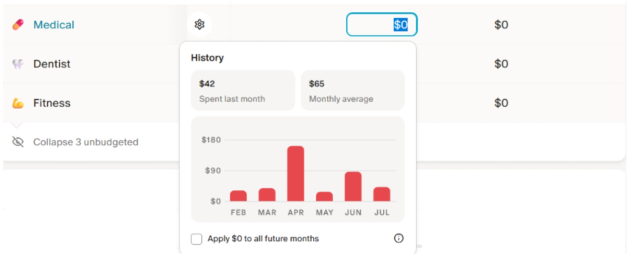
Knowing how much you spend is key to predicting your elections. Monarch can help you track your healthcare expenses month-to-month across different accounts, giving you a bird’s-eye view of your spending without having to hunt for them across different accounts. Monarch can average out your expenses for a long-term view and help you build them into your budget.

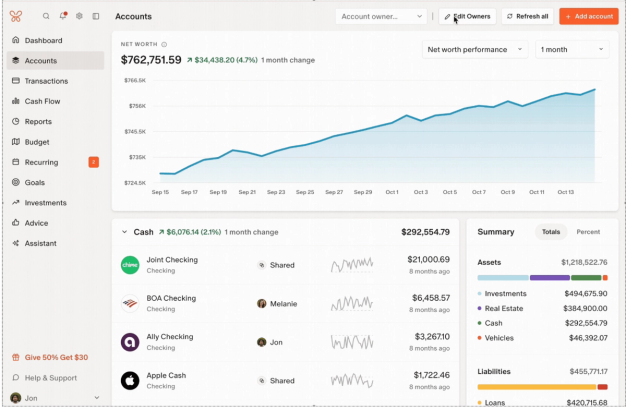
If you’re budgeting with a partner, you’ll want to be on the same page about your contributions and your balances. Shared Views allows you to connect your and your partner’s accounts so you can track expenses and contributions all on one dashboard.

If you want to learn more about budgeting for health expenses, check out our blog on health insurance plans and managing expenses.
When in doubt, save conservatively
The key thing to remember with HSAs and FSAs is what you stand to risk with your savings. FSAs in particular have a hard deadline on both deciding how much to save and how much you spend, with the price being forfeited savings. As such, a conservative FSA estimate is better than a generous one, especially if you pair it with a robust emergency fund or an existing, inactive HSA.
FAQs
What happens to unused FSA money?
Unused FSA money is forfeited to your employer to cover administrative costs, uniform coverage, and other expenses associated with maintaining your account.
Do I lose my HSA if I change jobs?
No, your HSA stays with you permanently. You can either continue to use your old account if you are on a qualifying HDHP insurance plan, pause your contributions, or roll it over to a new one.
Can I change my FSA contribution mid-year?
No, unless you have a qualifying life event such as the birth/adoption of a child, a change in employment or income, or marriage/divorce.
What are the disadvantages of an HSA?
HSAs aren’t available if you’re not enrolled in a high-deductible health plan or qualifying Marketplace plan, which means that you’ll run the risk of higher out-of-pocket payments on your insurance if you need healthcare. Any withdrawals you make for non-qualified expenses before the age of 65 will incur a 20% penalty on top of income tax. Additionally, being enrolled in an HSA means you and your spouse cannot enroll in an FSA.
Can an HSA or FSA pay for a gym membership?
No, unless you have a documented letter of need from a healthcare provider. HSA and FSA withdrawals can be made for qualified physical therapy appointments.
Do I need a high-deductible plan to get an HSA?
Yes, you need to be enrolled in a high deductible health plan to qualify for an HSA, either through your employer or the Health Marketplace. Not all HDHPs are HSA eligible so be sure to check during the enrollment period.