
For married couples, merging finances used to be a given as much as changing your last name or registering for wedding china. Now, however, you have more options than ever for sharing your finances or keeping them separate.
According to the U.S. Census Bureau, the share of married couples with no joint account climbed from 15% in 1996 to 23% in 2023. Whether or not you decide to merge your finances isn’t a statement on your relationship. It’s how you come to that decision, and how you involve your spouse and weigh your options, that determine if you’re on the same page about your financial big picture, and the success you’ll have moving forward.
Key takeaways
- Whether you choose to have a joint account, separate accounts, or a mix of the two, the core deciding factor is how you stay transparent and keep communication open.
- Merging finances is no longer the default. According to the Census Bureau, 17% U.S. couples favor a hybrid setup, and 23% keep their finances entirely separate.
- While some research shows merging your finances leads to better sustained relationship quality in the first couple of years of marriage, finding a system that works for you will help you in the long run.
Start with the money conversation
The key to combining finances isn’t whether you choose to do it or not. It’s how you get to that decision that matters and that will help build the foundations for handling finances as a couple in a healthy way.
To start, lay out the core parts of your finances and what will impact them. This includes:
- Your combined income
- Your cash flow and spending habits
- Your individual and shared debts
- Your credit cards and credit scores
- If you have any previous bankruptcies
- Your spending habits, including if you have had previous issues with overspending
- Your relationship with money
- Your financial goals moving forward
- What constitutes a “big purchase” and when you’ll want to run it by the other spouse
- Expectations for splitting bills and sharing income, such as whether one spouse wants to stay home while the other works
It’s crucial to be transparent when you have your money talks.
About two in five (38%) of Americans believe that keeping a financial secret is as bad as infidelity, according to a 2026 Bankrate survey. Despite this, 9% of Americans said they have kept a major debt, source of income, or expense from their partner.
While you don’t have to discuss every transaction in detail, laying everything on the table will make your first and future money talks easier to have, and help you with future planning.
Your three options: joint, separate, or hybrid
How you decide to combine your finances will impact how you split your expenses and manage your savings together, as well as how much risk you are taking on in terms of giving your partner access to your savings. Here’s a quick overview of the options you have available.
Transparency | Convenience | Autonomy | Risk | Best for | |
Joint | High | High | Low | High | Couples with high levels of trust and transparency |
Separate | Low | Low | High | Low | Couples who value privacy and autonomy |
Hybrid | Mixed | High | Mixed | Mixed | Couples who want the convenience and unity of sharing an account with backup options |
Joint
A joint account is the most straightforward way to combine finances, where all of your savings and expenses are shared. Two in five (40%) of all married couples keep their bank accounts jointly, according to the Census Bureau.
Keeping your accounts joint can simplify your finances, since you don’t have to worry about crunching the numbers on split bills. It’s also a popular option for couples who rely more heavily on one spouse’s income. It also ensures total transparency, since both partners can see income and transactions on the account.
This option is also the riskiest, as both partners have full access to the money and any withdrawals made on the account. If one partner defaults on a debt, then both partners’ assets are at risk of being seized. A joint credit card or loan also puts both partners’ credit scores on the line, especially if you miss a payment or default.
If you get divorced, splitting finances can be messy, especially if you don’t have a prenup or clearly outlined ownership rules.
Making your finances exclusively joint requires a high degree of trust, unity, and transparency in a couple. Make sure to discuss this thoroughly with your partner and understand the risks you’re taking on, especially if you have different incomes, different spending habits, or want some degree of privacy in your savings.
Separate
With separate accounts, what’s yours is yours and what’s your partners’ is your partner’s.
Keeping your accounts separate can make paying for shared expenses more complicated, and some couples may feel that entirely separate accounts create a lack of transparency or more opportunities for one partner to hide extra savings, investments, or major debt from the other partner.
However, it offers the highest level of privacy and the least amount of financial risk among the account configuration choices. Nearly one in four (23%) of couples choose to keep their accounts entirely separate, according to the Census.
Hybrid
The hybrid approach offers, for many couples, the best of both worlds. With this method, couples will have one or more shared accounts that they use for shared expenses and shared savings, while maintaining their own private accounts for their own expenses and savings. According to the Census Bureau, 17% of couples choose to merge their finances this way.
Hybrid accounts are highly customizable, since you can choose how many accounts you want to share or keep private, and allows for a bit more individual security and autonomy than completely merging accounts, while giving you more convenience and a more unified approach than keeping your accounts purely separate.
The shared credit card method
One way to have hybrid accounts without necessarily having a joint account is to start with a joint credit card for your shared expenses. This way, both of you can have a way to combine your expenses without needing a shared bank account, and you can choose to pay off your balance from individual accounts, or split expenses as you agree on.
A simple framework to choose your setup
When deciding on your account set up, ask yourself (and your partner) these four key questions:
- How balanced are our incomes? If you have unequal incomes, you may want to keep one shared or two accounts that you contribute to proportionally and separate accounts for your own savings.
- What existing debts do we carry individually? While you don’t have to merge debts or take on your spouse’s debt repayments, you should discuss how much responsibility the non-indebted partner has.
- How comfortable are we with full transparency? Merged accounts means everything is on the table, including access to money and transaction history.
- How much personal autonomy do each of us want? Merged accounts provide less autonomy, especially if you and your partner will want to run large purchases by one another.
While there are no right or wrong answers to these questions, asking yourselves this will help you refine your decisions and outline what your priorities are when choosing an account type.
How to split shared bills
While some couples pool their money and their expenses as a whole, if you choose to keep your accounts separate, you’ll have to figure out how you split your shared bills. Here are the three main approaches to consider.
Splitting 50/50
If your incomes and shared expenses are fairly equal, splitting bills equally can be your best option. Simply divide the bill in half and have each partner pay their share. For example, if your shared bills are $5,000, each partner would pay $2,500. You can choose to split each bill individually or pool your bills and split the sum.
Splitting proportionally
Splitting bills proportionally works well if you have uneven incomes. For example, if Partner A earns $3,000 a month and Partner B earns $7,000 a month, then Partner A would cover 30% of the bills and Partner B would cover 70% of the bills. In this case, for a shared bill total of $5,000, Partner A would contribute $1,500, and Partner B would contribute $3,500.
“My bills, your bills”
A more informal way of splitting bills can be to simply assign certain bills to each partner, with the assumption that expenses will even out in the long run.
For example, if your water bill is $50, your electric bill is $100, your gas bill is $75, and your trash removal bill is $25, then one partner can take on the water and gas bills, and the other pays for the electric and trash removal bill. This way, each partner is paying the same ($125) and you don’t have to worry about splitting bills each month.
Does merging money actually help your relationship?
In a nutshell: yes, it can.
A 2023 study in the Journal of Consumer Research found that newlywed and engaged couples who combined accounts were able to stave off the “two year decline” that many newly married couples experience, and reported greater alignment on finances, a more unified approach to tackling goals and issues, and more transparency in how they handled finances, especially when the couple had unequal incomes.
Of course, this doesn’t mean that merging your finances will automatically improve your relationship or your finances. While combining your accounts offer the benefits of a unified front, how you make that decision and how comfortable you are with it are more important. Not all couples are the same, and it may make more sense for you to keep some accounts separate instead of merging your finances completely.
What accounts can we legally merge after marriage?
Even if you’re all-in on merging your accounts, there are certain limits on what you can and can’t legally add your spouse to.
What you can merge:
- Bank accounts
- Mortgages
- Auto loans
- Personal loans
- Credit card accounts
- Insurance beneficiaries
- Trust funds (depending on the state and the trust conditions)
- House ownership
- Car ownership
- Brokerage account ownership
What you can’t merge:
- 401(k) and individual IRA accounts
- Spousal IRAs
- Trusts that do not allow for spousal ownership
- Health savings accounts
- Flexible savings accounts
- 529s
Another thing to consider is what you want — and are legally able — to will to your spouse when you pass. While some couples with dependents will automatically bequeath their assets to their spouse, others choose to bequeath some assets to other relatives or next-of-kin, or set up a trust.
Do I take on my spouse’s debt when we get married?
Not necessarily. Your spouse, unless they choose to add you to the debt account, is responsible for any payments on accounts they opened in their name alone. However, if either of you are on an income-based repayment plan, the payments may increase since both of your incomes are considered when calculating the payment.
In addition, if you have any joint accounts or assets with your spouse (such as a house, bank account, or brokerage account) and they default on a loan or file for bankruptcy, you stand a chance of having your assets seized.
Do I take on my spouse’s credit score when we get married?
Your credit scores will always remain individual. However, your score will be impacted by any joint loans or joint credit cards you have, which means that if the utilization ratio increases or if any payments are missed, both your scores will take a hit.
Your first year money checklist
When the wedding bells are done ringing, it’s time to get down to business to get your finances in order as a couple. Within your first twelve months as a married couple, you should:
- Agree on if and how you want to merge your accounts, and merge accounts
- Set up your budgeting and “money date” schedule
- Establish your first goals
- Get an official copy of your marriage certificate
- Change your name(s) on your Social Security account, financial documents and IDs (if you plan on changing names)
- Decide if you’re marrying filing jointly or separately
- Build a joint emergency fund
- Switch your health insurance, if desired
- List yourself as a beneficiary on your spouse’s life insurance and retirement accounts
- Update your wills, trusts, and power of attorney documents
How Monarch helps couples combine finances
Visibility, honesty, transparency, and accuracy are all core to building a budget and financial plan that works for you as a couple. No matter how you decide to combine your finances and share expenses, Monarch offers the tools to make your money work for you.
One of the biggest obstacles for couples keeping separate accounts is a lack of transparency into cash flow. Monarch offers you full visibility across all your accounts and transactions, giving you the full picture of where your finances are with automatic tracking. With Shared Views, both you and your partner can build a budget on a household account.

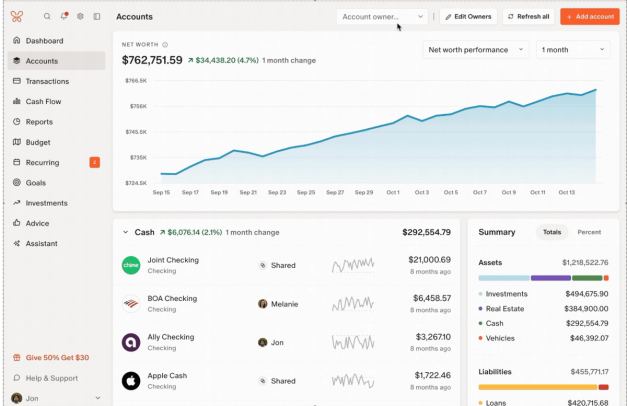
Shared financial goals are core to managing your finances as a couple. Track your progress for both savings and debt repayments with Monarch’s Save Up and Pay Down goals, which gives you and your spouse insights on your progress.


Building an actionable financial plan requires visibility and accurate data on your income, spending, and savings. Monarch’s reports function gives you weekly, monthly, quarterly and yearly snapshots of your cash flow and spending trends, giving you fuel for your money conversations and giving you more time to discuss the big picture of your finances — instead of hunting down transactions or juggling spreadsheets.

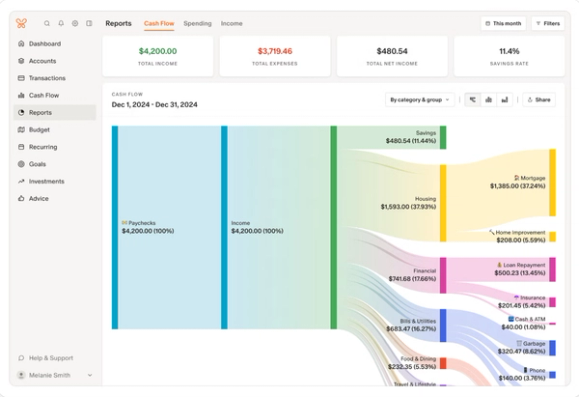
Whether it’s building a budget, managing your goals, or building a long-term financial roadmap with your partner, Monarch gives you visibility into you and your partners’ finances — no matter how you decide to combine them.
Decide deliberately, not by default
Whether or not you merge finances after marriage isn’t a black or white decision or even a decision you have to make and stick with right now. If you decide to combine your accounts, keep them separate, or take a hybrid approach, be sure to make the decision deliberately and transparently, keeping you and your spouse’s preferences and priorities in mind and as clear as possible. Honesty is the best policy in both your finances and your marriage, and with tools like Monarch, you can keep your finances transparent and make joint decisions in an informed way.
FAQs
Should we merge our finances after marriage?
That depends on you and your spouse. If you value privacy and security, then you may want to keep your accounts separate. If you value unity and transparency, you may want to merge accounts. If you want a combination of unity and privacy, consider having a few joint accounts and keeping other accounts separate.
What percentage of our income and finances should we merge?
Generally, if you choose to combine accounts and income, combine at least as much as it takes to cover your shared bills and goal contributions, such as housing payments, utilities, shared vehicles and debts, and combined goals.
Can you merge retirement accounts after getting married?
No, you cannot. Your spouse can be named a beneficiary of your account, however, and roll your savings into their own account in the event of your death.
What documents should we update after we get married?
You should update:
- Your insurance beneficiary documents
- Your retirement beneficiary documents
- Your will and estate documents
- Your tax forms
- Your Social Security Number (if you choose to change your name)
- Your license and passport (if you choose to change your name)
- Power of attorney documents
- Bank accounts (if you choose to merge them)
- Ownership documents for houses and vehicles
- Credit cards (if you choose to add your spouse as a joint user)
Am I responsible for my partner’s debt after we get married?
No, unless you decide to take on the debt jointly, such as becoming a joint user on a credit card account. There are a few circumstances where debt can be impacted by marriage. If the debt-holder is on an income-driven repayment plan, their minimum payment may increase, as both of your incomes are considered. As well, if your spouse files for bankruptcy or defaults on a loan, any jointly owned assets or bank accounts can be at risk of being seized.
Should we get a prenuptial agreement?
A prenuptial agreement can be helpful if you’re coming into a marriage with substantial assets of your own, like a house, a large amount of cash, or a trust, or have individual debts. It can also be useful if you want to outline an alimony agreement, especially if one spouse is heavily supporting the other with their income. Even if you don’t feel it’s necessary, a prenup can help get you on the same page about how you want to handle your finances and what your expectations are for sharing assets.