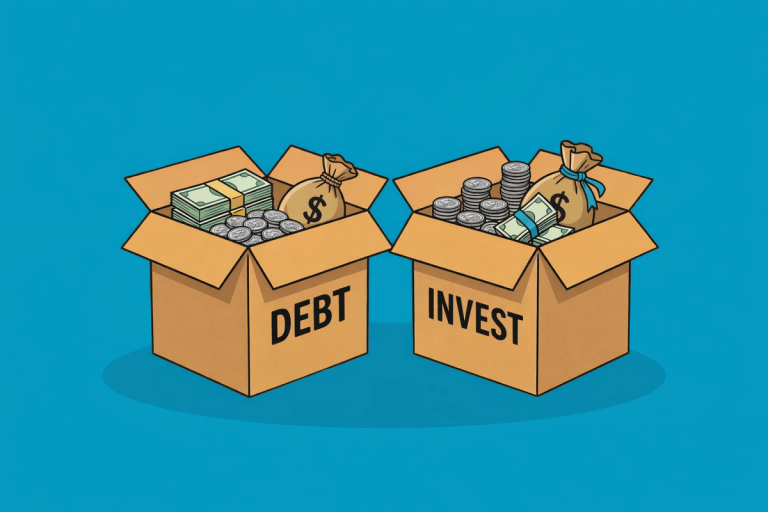
Did you receive a year-end bonus? Perhaps a decent sized tax return? Or maybe you’re earning more than you’re spending now and have a surplus at the end of each month. You’re probably wondering what millions of Americans are also wondering: should we use the extra money to pay down debt or invest it for the future?
There’s no one black or white answer. Some financial experts preach paying off every debt before investing a penny. Others say the math works better if you invest it in the market. The reality, though, sits somewhere in the middle. It depends almost entirely on your personal situation and your specific numbers.
This guide will walk you through a clear, step-by-step framework so you can stop second guessing yourself and start moving forward.
The One Number that Decides Everything: Your Interest Rate
At its core, the debt vs. investing question is a math problem. You are comparing a guaranteed cost (the interest rate on your debt) against an uncertain return (what the market might earn). When you pay down debt, you capture a return equal to that interest rate, with no risk, no volatility, guaranteed. When you invest, you’re betting on future performance that history suggests will average somewhere around 7-8% annually after inflation(for a diversified 100% stock portfolio), but with no guarantees.
That comparison gives us the foundational rule most financial planners use: if your debt’s interest rate is significantly higher than what you’d reasonably expect to earn investing, pay off the debt first. If your rate is low enough that investments would likely outperform it over time, investing might make more sense.
So what counts as “high” interest versus “low” interest? Financial planners usually draw the line somewhere between 7-10%. Debt above that threshold almost always warrants aggressive payoff. Debt below it, say a 3% mortgage or a 4% student loan, is relatively cheap enough that the math often favors investing instead, especially if it's in a tax-advantaged account.
The breakeven comparison isn’t just between your interest rate and the historical average return of stocks, though. It also depends on whether your debt interest is tax-deductible (like mortgage interest), whether your investment returns happen inside a tax-sheltered account (like a 401(k) or Roth IRA), and what type of investments you would use for the money if you didn’t use it to pay down debt. A 7% mortgage may have an effective cost of around 5% after deducting interest, while a 7% investment inside a Roth IRA grows completely tax-free, and an investment portfolio designed for short-term investing over the next 3-5 years may have expected returns of only 3-5%. The actual return you’d see in your pocket at the end of the day matters just as much as the headline rate.
The Priority Checklist: What to Do First, Second, and Third
Before you allocate a single extra dollar to debt or investments, there’s a clear order of operations that most financial planners agree on. Think of this as your financial hierarchy of needs.
Priority | Action | Why It Comes First |
1 | Build a starter emergency fund | Start with the higher of one month of net income or $1,000, so unexpected expenses don’t go straight onto a credit card. |
2 | Pay down debt with interest rates at or above 25% | Rates this high often mean the interest compounds more quickly than the free money you might be leaving on the table from your employer. |
3 | Get basic health, auto, and home insurance in place | Having minimum insurance in place prevents major emergencies from draining all your resources. |
4 | Capture your employer retirement match up to 6% of salary, if you have one | This is an instant return on your money. If your employer is really generous, though, stop at 6% of salary so you have some cash flow to continue paying down debt and save for emergencies. |
5 | Get basic life and long-term disability insurance in place | If applicable, these can help prevent you and your loved ones from financial catastrophe. |
6 | Pay off high interest debt with rates above 7-10% | Reliably outperforming a 7–10%+ interest rate through investing is unlikely. |
7 | Build a full emergency fund (3-12 months of living expenses) | Prevents the need to add debt in a crisis or deplete investments. |
8 | Get your full employer match | If your employer matches more than 6% of salary, get the full match so you’re not leaving free money on the table. |
9 | Maximize tax-advantaged accounts (401(k) and IRAs) | Tax-free and tax-deferred growth dramatically compounds over time. |
10 | Pay off moderate interest debt with rates above 5-7% | Math becomes a closer call, personal preference and risk tolerance matter here. |
11 | Invest in taxable accounts/payoff low interest debt | You have flexibility once the foundation of your finances is built. |
This isn’t rigid or set in stone, but it is a sensible starting point for most households. The logic is very simple: no investment strategy survives a financial emergency that forces you into high interest debt, and no rational investor should skip free money from an employer match.
When You Should Always Pay Off Debt First
There are certain situations where the answer is clear cut and you should prioritize debt repayment. Let’s have a look:
- Your interest rate is above 7%. Credit card debt averaging above 20% APR in today’s environment has a cost that no realistic investment return can reliably beat over time. Paying down a 22% credit card is highly likely to be more impactful and positive for your finances than any index fund.
- Debt is causing financial stress that affects your behavior. If anxiety regarding your balances is making you avoid looking at your finances, avoid career decisions, or neglect retirement planning, eliminating it has value far beyond just the math.
- Your debt-to-income ratio is limiting your options. Lenders look at this ratio when you apply for mortgages, car loans, or even apartments. High debt loads don’t just cost interest; they also constrain your future flexibility.
- You have variable-rate debt in a rising interest rate environment. A home equity line of credit or variable rate student loan that started at 5% may now be at 8% or higher. The calculus on this debt can shift quickly.
- You have no emergency fund at all. Taking investment risk without a cash cushion is a trap. One car repair or medical bill puts you right back in debt and often at high interest rates.
When Investing Should Come First
The math and circumstances sometimes clearly favor investing, or at least doing both simultaneously. Lean toward investing in the following scenarios:
- Your employer offers a 401(k) match and you’re not capturing all of it. A 50% match on your contributions up to 6% of salary is a 50% return before the market moves at all. Skipping free money from an employer is most likely irrational, unless the match is super generous and would cause you to go into debt to fund your day-to-day expenses.
- Your debt carries a low interest rate. A 2.5% car loan or a 3.5% mortgage taken during the low interest rate era cost less than what a diversified portfolio has historically returned over a long period of time. The opportunity cost of aggressively paying these down early might be substantial.
- You have a long investment time horizon. Compound interest is time-dependent. Every year you delay investing in your 20s, 30s, and beyond costs you more and more in foregone compounding. A dollar invested at 25 years old has vastly more time to grow than a dollar invested at 45 years old.
- Your debt is already under control. If you’re current on all payments, have a growing emergency fund, and your monthly cash flow is healthy, there’s really no urgency to accelerate payoff beyond the minimum on low rate loans. The caveat here is that you can pay off the rest of your debt if it is weighing on you emotionally or psychologically. Sometimes the best mathematical option doesn’t align with what’s best with our mental well-being. In this case, it’s your judgment call.
- You have tax-advantaged account space you’re not using. Roth IRA contributions, for example, can only be made in the current tax year. Not maxing out your contributions this year means that extra room in the account is gone forever. This is an opportunity cost.
The Hybrid Approach Most Experts Actually Recommend
The majority of people in good financial health pay off debt and invest simultaneously. The “pay off debt or invest” framing is often misleading because it implies this is simply a binary choice. For most people with moderate rate debt and a steady income, a split strategy makes the most financial psychological sense.
A common framework is the 50/50 split. Once you’ve covered the basics (like an emergency fund, full company match, and paying down high interest debt) divide the remaining surplus equally between accelerating debt payoff and investing. This strategy provides the best of both worlds.
Another approach is the waterfall method of paying minimums on everything, then direct all extra cash to one target at a time such as the highest interest rate debt first (avalanche method) or smallest balance first (snowball method). Once the debt is gone, roll that payment into the next target. The math favors the avalanche method, but the psychology of early wins from the snowball method keeps many people on track who would otherwise quit.
According to Vanguard’s annual “How America Saves” research, the median 401(k) participant contributes around 7% of their income. This suggests most people are investing something even while carrying debt. The question isn’t really whether to do both, but how to optimize the split.
Lastly, there’s a debt repayment method called “defrosting”. It is a hybrid paydown approach where you focus on aggressively paying down high interest debt until the utilization rate is under 30% (positively impacting your credit score). Once the 30% target is hit, and you see a rise in your credit score, you can pursue a 0% balance transfer. The balance transfer will allow you to tackle the debt faster during the 0% rate time period.
What Your Debt Type Means for the Decision
Not all debt is created equal. The interest rate matters the most, but the type of debt also carries tax implications, repayment flexibility, and psychological weight that affect how you should treat it.
Debt Type | Typical Rate Range (based on current rates) | General Guidance |
Credit card debt | 17-30% APR | Highest priority. Pay aggressively before almost any investment. Consider a 0% balance transfer and work with your lender to lower the rate if possible. |
Personal loans | 10-20% APR | High priority. Pay before most investing. |
Auto loans | 6-12% APR | Depends on your rate and whether you’ve fully taken advantage of your employer match yet. |
Federal student loans | 5-7.5% APR | Depends on what plan. Income driven repayment and forgiveness programs add complexity. |
Private student loans | 6-14% APR | Treat like an auto or personal loan based on the actual rate. |
Mortgages | 6-7.5% APR (current rates) | Borderline. Capture tax-advantaged space before extra principal payments. |
Low-rate mortgages (pre-2022) | 2.5-4% APR | Almost always better to invest than prepay. The rate is lower than expected long-term returns. |
Student loans deserve special mention here. Federal loans come with income-driven repayment options, potential forgiveness programs, and deferment options that private loans don’t offer. The flexibility has value even if the interest rate alone would suggest payoff. If you’re pursuing the Public Service Loan Forgiveness (PSLF), aggressively paying down federal loan principal could actually work against you. You may want to keep the balance high enough to maximize the forgiveness amount at the end of the qualifying period. Monarch’s student loan guide can help you work through decisions regarding this matter.
The Psychology of Debt: Why the Math isn’t the Entire Story
Behavioral economics has a lot to say about why people make suboptimal financial decisions. The debt vs. investing choice is a perfect case study. Understanding these tendencies doesn’t make you immune to them, but it does help you design a plan that works with your psychology rather than against it.
Loss Aversion: People feel the pain of loss roughly twice as strongly as the pleasure of an equivalent gain. This can make debt feel more urgent than it mathematically is. This is sometimes a feature, and not a bug, however. If the discomfort of carrying debt motivates you to pay it off faster than the math strictly requires, and that discipline extends to your overall finances, the emotional benefits may be worth the marginal opportunity cost.
Present Bias: We consistently overvalue immediate relief versus future gains. Paying off debt today gives an immediate, tangible sense of progress. Investing for retirement gives you a number on a screen that won’t feel real for decades. This asymmetry often leads people to underinvest, even when the math favors it. The future reward doesn’t feel as real as the present debt.
Mental Accounting: Most people mentally separate “debt money” and “investment money” as if they live in different buckets. In reality, a dollar used to pay down high interest credit card debt produces the same financial result as earning the same interest rate on an investment. The bucket shouldn’t matter, but it often does.
Status Quo Bias: Many people stay on the minimum payment track simply because changing the default requires effort. Building automation into your plan (automatic transfers to savings accounts, investment contributions, extra debt payments) removes the friction that keeps inertia in charge. The bottom line is that the psychologically correct answer is whichever approach you will actually see through. A mathematically optimal plan you abandon halfway beats nothing. A slightly suboptimal plan you execute consistently for a decade will outperform it handily.
Expert Perspectives on the Great Debate
The financial planning community isn’t a monolith on this question, and understanding where different schools of thought come from helps calibrate their advice to your situation.
For example, some debt-first advocates use a framework that prioritizes aggressively paying off almost all debt before tackling any other goal. The logic behind this method is purely behavioral. The debt is a psychological anchor that limits risk-taking and wealth-building. One expert’s audience skews toward people who have struggled with debt and need the psychological clean slate.
Index-fund prioritizers strongly believe time in the market is the most powerful wealth-building tool available to ordinary investors. Every year you delay investing in a low cost index fund is a year of compounding you can never recover. They advocate capturing tax-advantaged space aggressively, even while carrying moderate-rate debt.
Most fee-only Certified Financial Planners (CFPs) land somewhere in between: capture the employer match first, pay off high-interest rate debt aggressively, then split the difference based on individual risk tolerance, your tax situation, and life goals. The SEC’s Investor.gov resources also echo this balanced approach.
What’s notably absent from most mainstream advice is any real accounting for inflation’s impact on debt. A fixed-rate 4% student loan in a 3% inflation environment has an effective real cost of just 1%. Inflation quietly erodes the real value of fixed debt over time, a dynamic that makes low-rate fixed debt even less urgent to eliminate aggressively.
The Bottom Line: Your Answer is Personal and it Evolves
The debt vs. investing decision doesn’t have a universal answer, but it does have a personalized one. Now you have the framework to find it. The interest rate on your debt is the most important variable. The employer match is the most commonly missed opportunity. A hybrid approach that does both, even if imperfectly split, beats “analysis paralysis” every time.
The best financial decisions aren’t made once. They’re revisited as your income grows, your debt balances decline, your investment accounts compound, and your life inevitably evolves. What’s right for you at 28 years old with $40,000 in student debt may be completely different a decade later with a mortgage and young family.
That’s why having all of your accounts, balances, debt rates, and goals in one place isn’t just convenient, it’s the foundation of executing on a plan. Monarch is built to be the execution layer. It is the place where your decisions turn into a budget, goals with target dates, and a dashboard that keeps you on track. It’s a complete picture of your finances that provides a framework for informed decision making.
You have the variables, the thresholds, and the order of operations to succeed and make the right call. Your goals are within your reach.
FAQs
What interest rate should I pay off debt before investing?
The most commonly cited threshold is around 7-10%. Debt above this range almost always warrants aggressive payoff because it’s difficult to reliably earn more investing after accounting for taxes and risk. Below 7%, the math increasingly favors investing, particularly in tax-advantaged accounts. Personal comfort with debt matters, too.
Should I stop my 401(k) contributions to pay off debt?
Generally speaking, no, you should not. At minimum, contribute enough to capture your employer match at least up to 6% of salary before directing extra cash to debt. That match is an immediate return on your contributions. If you have extremely high interest debt at or above a 25% rate, we’d suggest stopping contributions temporarily to work on paying down the debt, then restoring them once the debt is eliminated.
Can I invest and pay off debt at the same time?
Absolutely, and for most people with moderate-rate debt, a split approach makes sense. The binary framing is often misleading. Once you’re capturing your employer match and have eliminated high interest rate debt, splitting your monthly surplus between accelerated debt payoff and additional investing is a perfectly reasonable strategy. The optimal split depends on your specific interest rates, tax bracket, and time horizon.
Should I use my tax refund to pay off debt or invest?
Apply the same framework. If you have high-interest debt, direct the refund there first. If your debt rates are low, a hybrid split is reasonable. At Monarch, we also believe taking a small portion of a windfall, like 10-20%, and using it on yourself is completely fine. As long as you’re putting the majority of the money to work, rewarding yourself every now and again is justifiable. Use the guidance in the article above to determine your personal strategy for the 80-90% of the tax refund you’ll use to improve your financial situation.
Is paying off debt really a “guaranteed return”?
Yes, in the precise sense that it eliminates a known, certain cost. If you pay off a 20% APR credit card, you’ve guaranteed yourself a 20% return in the form of avoided interest charges. This makes high interest debt uniquely compelling compared to investing, where returns are uncertain and volatile. The “guaranteed return” framing is most powerful for debt above 10%.
How much debt is too much to start investing?
There’s no absolute threshold, but two conditions should be met before prioritizing investing over debt. First, your monthly minimums are covered and you’re not adding to high interest rate balances. Secondly, you have at least a small emergency fund so that unexpected costs don’t force new debt. Once those boxes are checked, you can reasonably begin investing even if you still carry significant balances at moderate interest rates.
Should I pay off my mortgage early or invest?
For most homeowners with pre-2022 mortgages at 3% or 4%, the math strongly favors investing over extra principal payments. Current mortgages are higher, often exceeding 6%, so it’s a closer call. Most planners still suggest maxing out tax-advantaged accounts before making extra principal payments, since the tax benefits of those accounts can shift the effective comparison meaningfully. It’s also important to note your emotional and psychological feelings around debt. If it would serve your mental health better to completely get rid of debt, even if it’s not mathematically the best option, it is worth considering and shouldn’t be ignored.
What should I do with a $10,000 windfall: pay debt or invest?
Run through the priority checklist. First, do you have a full emergency fund? If not, build it. Next, do you have debt with a high interest rate? Prioritize eliminating it. Third, have you maxed out your IRA contributions for the year? If not, that’s a strong use of extra money. Lastly, if there is moderate interest rate debt and you’d sleep better at night with it gone, then go ahead and pay it down. If not, you could invest the money or split it between debt and investing. Be intentional with your choice and base it on your personal situation and psychology. While you’re building your financial foundation, with any windfall you can take 10-20% off the top to do something for yourself. Then put the remaining 80-90% to work following the priority checklist.