When your golden years beckon, it will be time to start digging into your 401(k) accounts and making withdrawals from your hard-earned retirement savings.
Withdrawing from a 401(k) isn’t as simple as getting a check from your servicer, however. Here are the rules to know about 401(k) withdrawals, penalties, taxes, and how to make your withdrawals the strategic way for maximum savings.
What is a 401(k) Withdrawal?
401(k) withdrawals are when you start taking out money saved in your 401(k) account. Since 401(k) balances are typically held in various types of investments, when you make a withdrawal, your stocks, bonds, and other holdings are sold for cash by your account servicer.
The IRS sets rules around withdrawing from your 401(k) based on your age, with penalties for withdrawing too early. This is why it’s not recommended to withdraw from your 401(k) before age 59½ unless you qualify for an exemption, and to work with a retirement finance professional to help you determine if it’s the right financial move.
Because it’s made up of investments, your 401(k) balance can grow and shrink with market fluctuations until you or your account servicer sell the investments in the account.
There are a few options for how you can take the money when withdrawing from your 401(k). You can choose to have regular periodic dispersals, also known as an annuity. Like a paycheck, these are sent to you as a check or via direct deposit to your bank account, and are a set amount. You can also choose to take out a lump sum, which you can request through your 401(k) servicer.
401(k) Withdrawal Rules
The biggest rule to follow for 401(k) withdrawals is the age threshold: You can only start making withdrawals from your 401(k) at age 59½. Withdrawing before that point could incur a 10% penalty on every withdrawal you make, on top of potential income taxes if you or your employer contributed to the account with pre-tax funds. This extra penalty is to discourage account holders from withdrawing and spending their retirement money too early. There are some exceptions to this penalty, including taking withdrawals from your 401(k) account with the company you retire from if you are at least age 55.
Required Minimum Distribution Rules
Once you reach age 73, you have to start withdrawing from your 401(k) at least annually under required minimum distribution (RMD) rules. The deadline for withdrawal is December 31 each year, beginning April 1 the year after you turn 73.
This rule applies to 401(k)s, 403(b)s, and IRAs, which means you don’t want to let any of these retirement accounts sit too long without a withdrawal. You can delay an RMD if you are still employed for a current employer’s plan, so long as you don’t own more than 5% of the business.
How much your RMD has to be is based on your account balance and your life expectancy factor, which changes each year and is established by the IRS.
To do so, you divide your current account balance by your life expectancy. If you are age 75, for example, are a single filer, and have $500,000 in your account, your RMD would be:
500,000 ÷ 24.6 =$20,325.20
You can also use a calculator to find your RMD.
The penalties for not taking a RMD are stiff. The IRS will charge you 25% of your account balance if you don’t withdraw by the deadline each year, though this can be downgraded to 10% if you withdraw the minimum amount within two years, on top of the current year’s RMD.
Taxes and Withholding on 401(k) Withdrawals
Tax and withholding rules for 401(k) withdrawals depend on the kind of 401(k) account you have, and whether your contributions were made pre- or post-tax.
With traditional 401(k)s, your contributions are made pre-tax, which means that your withdrawals are taxed according to your tax bracket for the year in which you take the withdrawal, which is calculated based on how much and what type of income you’re bringing in that specific year.
In this case, retirement withdrawals from pre-tax retirement accounts are counted as taxable income. This goes for all taxable withdrawals you make across your retirement accounts. Each retirement account custodian will provide you with a summary of your withdrawals from your account(s) with them, if you made any, in the form of a Form 1099-R.
Accounts with taxable withdrawals include:
- Traditional (pre-tax) 401(k)
- Traditional (pre-tax) 403(b)
- Post-tax, non-Roth 401(k) - the earnings on the post-tax, non-Roth contributions will be taxable if they are not converted to Roth-type funds
- Traditional IRAs with deductible (pre-tax) contributions and their earnings and/or earnings from non-deductible contributions
- Rollover IRAs with pre-tax/deductible contributions and earnings
- Pensions
- Annuities (the portion that was earnings and not contributions will be taxable)
- Social Security, if the total of your adjusted gross income, tax-exempt interest income, plus half of your Social Security benefit income is over $25,000 for single filers or $32,000 for married filing jointly
- Brokerage or investment divestments - the earnings on anything you sell or distributions in the form of dividends or interest will be taxable
Some retirement accounts have tax-free withdrawals if your contributions were made post-tax. These withdrawals do not count toward your taxable income or your tax bracket.
Accounts with tax-free withdrawals include:
- Roth IRA
- Roth 401(k)
- Post-tax, non-Roth 401(k) - the contributions will be tax-free
- Roth 403(b)
- Traditional IRAs with non-deductible contributions - the portion that is made up of non-deductible contributions will be tax-free
- Social Security, if if the total of your adjusted gross income, tax-exempt interest income, plus half of your Social Security benefit income is under $25,000 for single filers or $32,000 for married filing jointly
As an example, let’s list out the income for a set of retirement accounts for the year, which will determine how much tax the household will need to pay. This is assuming the account holder is making no additional income from investments, business, or work, and is not yet receiving Social Security benefits or any other form of income, which would count toward the total household income if this is the case.
Account Type | Taxable | Annual Withdrawals | Annual Taxable Withdrawals |
Traditional 401(k) #1 | Yes | $55,000 | $55,000 |
Traditional 401(k) #2 | Yes | $12,000 | $12,000 |
Roth 401(k) | No | $5,000 | $0 |
Roth IRA | No | $6,500 | $0 |
Traditional IRA | Yes | $1,000 | $1,000 |
Rollover IRA | Yes | $15,000 | $15,000 |
Total | $94,500 | $83,000 |
With this household’s annual taxable income set at $83,000, your federal income taxes would be, for the 2025 tax year and assuming the standard deduction and no additional deductions or tax credits:
- If filing singly, $1,192.50 plus 22% over $48,475, or $9,874
- If married and filing jointly, $2,385 plus 12% over $28,350, or $5,883
While you don’t have to pay Social Security or Medicaid taxes on your 401(k) withdrawals, you will still have to pay state and local taxes on top of your federal taxes, the amount of which will depend on where you live.
How do I Withhold Taxes on My 401(k) Withdrawals?
When you begin making withdrawals from your 401(k), your 401(k) company will usually withhold 20% of your lump-sum distributions as a default. This generally cannot be adjusted, which means you’ll have to wait until you file taxes and receive your refund to get your money back.
If you choose to instead take out automatic periodic withdrawals on a weekly or monthly basis, you can adjust your withholding according to how much you expect to owe at tax time. If you don’t withhold enough in either case, then you will owe taxes that have to be paid the following year when you file.
Exceptions: How to Withdraw Early Without Penalty
While the IRS doesn’t want you to withdraw from your retirement accounts too early, there are some ways you can withdraw from your 401(k) before retirement age without having to pay the penalty. All withdrawals will still be subject to the regular income tax, if applicable.
These exceptions include:
- Qualified birth or adoption expenses. If you or a spouse adopt or give birth to a child, you can withdraw up to $5,000 per child.
- Disability. If the account holder becomes permanently and totally disabled, they can begin withdrawing.
- Disaster recovery. If you are in a federally-declared disaster area and experience an economic loss related to the disaster, you may withdraw up to $22,000.
- Domestic abuse. Survivors of domestic abuse can withdraw up to either $50,000 or 50% of the account, whichever is less.
- Emergency personal expenses. Once per calendar year, you can withdraw the lesser of up to $1,000 or over $1,000 vest account balance, in order to cover an emergency or family expense.
- Job separation at age 55. If you leave or are laid off from your job at age 55 or later, you can start withdrawing from your former employer’s specific account without penalty. Note that this rule does not apply to other employer’s 401(k)s or IRA accounts.
- Medical expenses. You can withdraw in order to pay unreimbursed medical expenses exceeding 7.5% of your adjusted gross income.
- Paying the IRS. If the IRS places a levy on your 401(k) due to unpaid taxes, you can withdraw enough to pay the balance without penalty.
- Substantially Equal Periodic Payments. Under Tax Code 72(t), you can elect to receive regular periodic withdrawals until the age of 59½ or for five years, whichever is longer. These withdrawals are the same each period and cannot be changed once determined, at risk of being penalized retroactively.
- Active duty military reservist withdrawals. If you are called to active military duty as a reservist for over 179 days, you can make withdrawals within that period. Note that you cannot make any contributions for a six-month period after any withdrawal in this fashion.
- Long-term care insurance. You can withdraw up to $2,600 yearly to help pay for long-term care insurance premiums.
- Hardship withdrawals. You can make a case to your employer for a hardship withdrawal for a heavy and immediate financial need, such as medical, housing, and disaster emergencies. These withdrawals are determined by your employer, and are limited to the exact amount you require for hardship.
While withdrawing from your 401(k) early can give you a helpful cash infusion, be sure to do so cautiously. Early withdrawals can translate into thousands of dollars of lost out compounding investments and severely curb your savings come retirement time. Instead, consider using your emergency fund, or taking out a 401(k) loan.
401(k) Loans: Borrowing Instead of Withdrawing
401(k) loans allow you to borrow against your 401(k), giving you access to cash without the early withdrawal penalty. You pay the loan back to yourself over time, with the vast majority of your payments and interest going back into your 401(k) account as you pay off the balance.
Borrowing limits are the lesser of:
- $50,000, or
- 50% of your vested account balance, or
- $10,000, if 50% of your vested account balance is less than $10,000
Interest rates and repayment terms depend on your employer’s plan. Some plans may also set limits on the number of times you can borrow in a given period.
401(k) loans can be useful since you don’t incur early withdrawal penalties, and you can still preserve the power of compound investing as you pay back your balance. Any interest you pay goes directly into your account, minus a small fee for the account servicer to help facilitate the loan. Additionally, missed payments don’t count against your credit score.
On the downside, if you leave your employer’s plan, then you may have to pay back the balance all at once or in the span of a few months. If you miss too many payments and default on the loan, the loan will become an early withdrawal and you’ll have to pay the penalty on the loan balance. You’ll also miss out on the potential growth of the funds you borrowed.
Smart Strategies and Tips for 401k Withdrawals
While it might be tempting to simply set your retirement account dispersals on automatic and sit back on the beach, being smart with how you withdraw can save you in the long run.
Minimizing your taxable income is the name of the game for 401(k) withdrawals. Keeping to a lower tax bracket keeps more money in your pocket while still leaving room for your everyday expenditures.
Here are some strategies to consider.
The 4% Rule
As a rule of thumb, experts recommend that you withdraw no more than 4% of your total retirement savings each year if you want to preserve the balance at the start of retirement over your lifetime.
For example, if your account balance is $800,000 at the beginning of retirement, you would withdraw up to $32,000 in the first year. In the second year, you would add 2% ($640) to this balance, making your maximum withdrawal $32,640. In the third year, you would add another 2% ($652.80), making your maximum withdrawal $33,292.80, and so on.
This allows you to withdraw enough to live comfortably compared to your previous salary, and gives you enough savings that can still grow over time.
Keep in mind that the 4% rule isn’t a hard-and-fast rule that you have to adhere to. How much you withdraw from your 401(k) will also depend on:
- Medical expenses. You may need to withdraw more if your medical expenses increase.
- Inflation spikes. If inflation increases, you may need to adjust your withdrawals to compensate for the cost of living.
- Market forces. If your portfolio takes a dip due to a market slowdown or recession, you may want to reel back your withdrawals while your stocks recover.
- Change of lifestyle. If you decide to move somewhere where the cost of living is cheaper, you may not need to withdraw as much.
- Taxes. If you withdraw too much in one year, you may bump yourself up another tax bracket and have to pay more.
Taxable First, Tax-Exempt Later
With this strategy, you empty out any accounts with taxable withdrawals, such as traditional 401(k)s, traditional IRA, and rollover IRA, first, and only withdraw from accounts where withdrawals are tax exempt, such as Roth 401(k)s, later.
This strategy not only allows your balance in your non-taxed accounts to grow more, but it also allows you to exempt your taxes when you have to start withdrawing on RMDs, especially if your account balances have been growing in that interval.
Dynamic Withdrawals
Dynamic withdrawals, as known as the guardrail method, allows for flexible withdrawals that account for fluctuations in the stock market. With this method, instead of following the 4% rule, account holders set a “high” guardrail and “low” guardrail of what percentage they can comfortably withdraw, with a target guardrail in the middle.
For example, if your target guardrail is 6%, your high and low guardrails would be 8% and 4%, respectively.
Using this, you can adjust your withdrawals to how your portfolio is looking. If you're withdrawing below your lower guardrail because your portfolio grew, then you can increase your withdrawals by 10%. If you’re over your high guardrail because your portfolio is struggling, you should decrease your withdrawals by 10%.
Ultimately, how you withdraw from your 401(k) and other retirement accounts will depend on your individual situation. If you have any doubts or questions, it’s best to speak with a financial advisor who can help you find the best amount for you to withdraw.
Budgeting Your 401(k) Withdrawals with Monarch
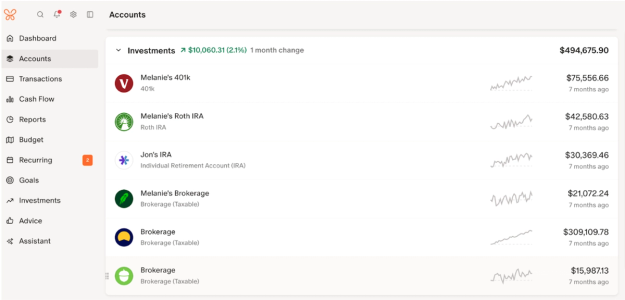
Keeping track of your 401(k) balance, withdrawals, and your retirement accounts all in one place doesn’t have to be difficult. Monarch can help you stay on track and stick to your withdrawal strategy, leaving you with more time for cruising, gardening, and pickleball.

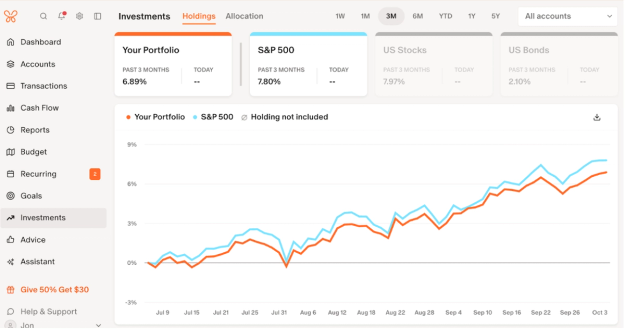
Monarch helps you track your accounts’ balances all in one place, linking accounts so you don’t have to juggle multiple logins over multiple services. You can get your total balance and your net worth at a glance, and keep an eye on market fluctuations over time, and link accounts with your partner or spouse.

Monarch’s cash flow feature helps you track your budget so you can adjust your withdrawals, as well as track how much you’re bringing in from your withdrawals. If your cost of living is creeping up, you can change your strategy either by withdrawing more or seeing where you can cut back.
Finally, Monarch can help you connect directly with your financial advisor to holistically look at both your budget and your 401(k) holdings, allowing you to form a smart strategy around your 401(k) withdrawals.
Don’t sweat the details of retirement. Let Monarch help you take the reins and give you agency over how you spend both your money and your golden years.
Conclusion: Weighing Your Options for a Healthier Financial Future
401(k) withdrawals come with certain rules and restrictions that help protect your savings until your retirement years. By focusing on saving early on, relying on 401(k) loans instead of early withdrawals, and only taking withdrawals after age 59½, you can help your retirement balance grow. Strategizing your 401(k) withdrawals in your retirement to keep your tax rate low can help you save money, while still giving you enough to comfortably live and enjoy your golden years.
FAQs
Does withdrawing from a 401(k) affect my Social Security?
It does not. Your Social Security is calculated based on how much you contributed during your working years, not how much you’re getting from your 401(k). However, it does impact whether your Social Security is taxable if your retirement income exceeds a certain threshold.
Can I withdraw my entire 401(k) balance at once?
You can do so without penalty once you reach age 59½. However, it’s not recommended you do so, as you’ll have to pay more taxes due to the marginal tax rate. As well, withdrawing your balance all at once means you’ll miss out your investments growing in your portfolio during your retirement.
How do I avoid the 20% tax withholding on a 401(k) withdrawal?
You can either roll your 401(k) into an IRA, which has more flexibility with choosing how much you withhold, or elect to have regular monthly withdrawals instead of a lump sum withdrawal.
How do I report a 401(k) withdrawal on my tax return?
401(k) withdrawals are reported under pension/annuities income on your Form 1040. You’ll get a Form 1099-R from each company where you take a withdrawal during the year that you’ll use to report your withdrawals on your tax return.
Can I withdraw from my 401(k) while still employed?
You can, but typically only for severe financial hardship and it may come with penalties. Withdrawing before age 59½ will come with a 10% tax penalty unless you claim one of the withdrawal exemptions established by the IRS. If you’re still employed after age 59½, you can make withdrawals without penalty, though you may be better off letting your funds sit and grow while you’re still bringing in a salary. You’ll most likely also be prohibited from contributing to the 401(k) plan again for a certain period of time if you take a hardship withdrawal, so if your employer offers any matching on contributions, you won’t be able to take advantage of those.